Why Fall is the Prime Season for Running Track Installation & Resurfacing
Read More
In the world of managing sports facilities, a track is almost never just a track. The running track is used in all different ways for schools, cities, and private sports complexes. It can be used for a lot of different things, like high-stakes 100-meter sprints and relay races, soccer games, field events, and community walking programs.
Keystone Sports Construction knows that the accuracy of the stripes makes all the difference between a well-run facility and a messy one. It’s not just about how the lines look; it’s also about safety, following the rules, and getting the most out of your investment.
Before a single drop of paint touches the surface, we must look to the governing bodies that dictate the dimensions of competition.
Depending on your facility’s primary use, we adhere to standards set by:
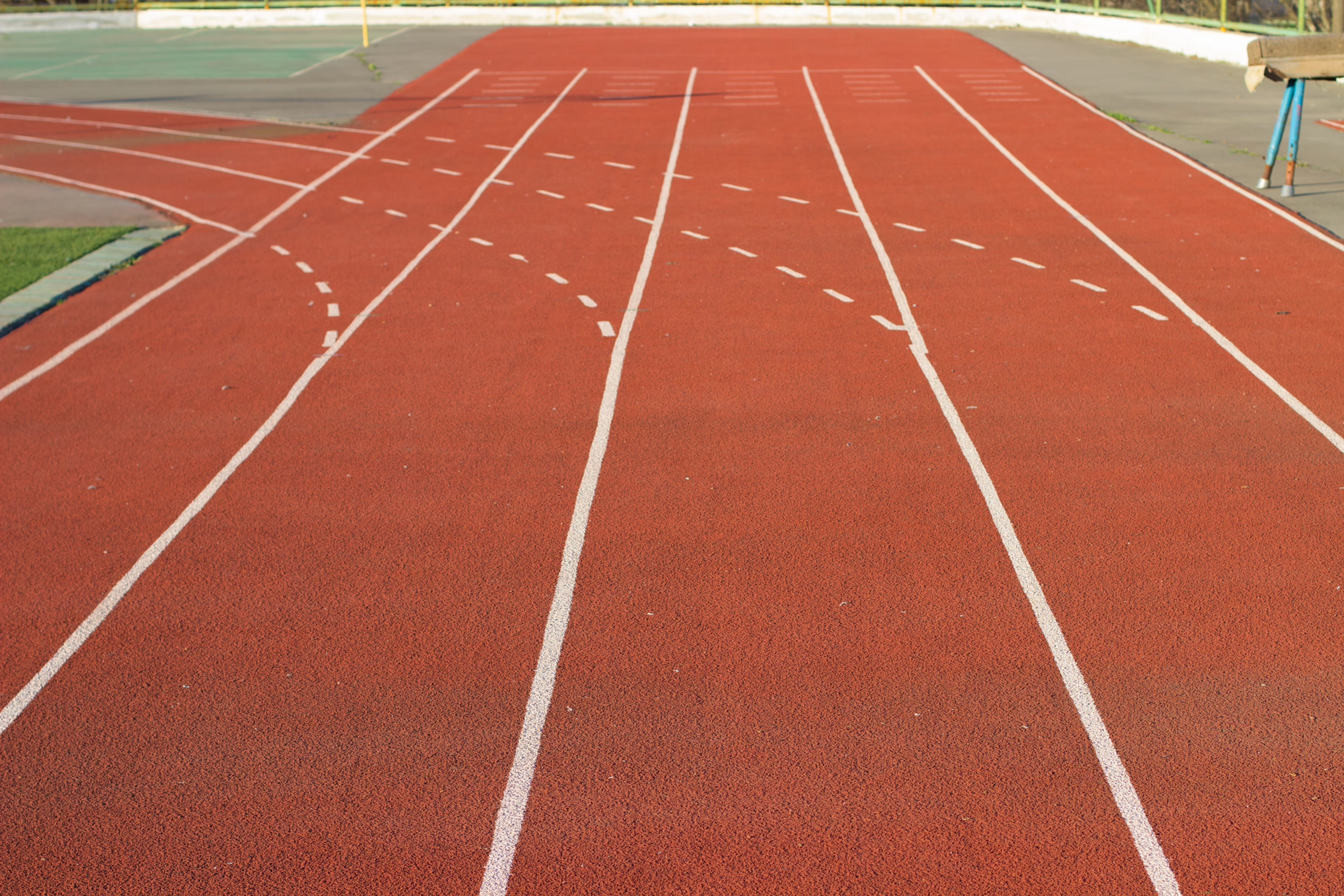
The standard running track is a 400m oval shape. Nevertheless, the process of placing lines on the track becomes complicated because of the “stagger.” The reason for this is that the outer lanes are further away from the center than the inner lanes, hence necessitating that distances be calculated accordingly for running track construction in PA.
On a multi-use track, the surface can quickly become a “rainbow” of lines. Without a logical color-coding system, athletes and officials can become confused. While specific colors can be customized to match school branding, the industry typically follows a standardized color hierarchy to instill clarity.
White is almost exclusively reserved for the main lane lines, the finish line, and the primary start lines for standard distances (100m, 200m, 400m). These are the “bones” of the track.
Relay races are won or lost in the exchange zones. Because there are different types of relays (4x100m, 4x400m), the zones are often color-coded to help runners identify where they must hand off the baton.
Hurdle placements are indicated by small “ticks” or “hashes” on the side of the lane lines. Because different races require different hurdle heights and spacings, these are often the most complex part of the marking process.
Many tracks encircle a “D-zone” or a central synthetic turf field used for soccer, football, or lacrosse. This creates a unique challenge: line overlap.
When we design a multi-use facility, we prioritize the primary sport with solid lines and use “shadowing” or dashed lines for secondary sports. For example, if your track doubles as the boundary for a soccer pitch, we check that the soccer markings are distinct in color (often yellow or white) and thickness so officials can make clear out-of-bounds calls without confusing them with track lane markings.
Keystone Sports Construction does not use regular household paint for our line markings. Specialized line marking on specialized sports surfaces, such as the latex system or polyurethane “sandwich” system, demands the highest quality aliphatic polyurethane or acrylic-based water paint.
Why the Material is Important:
Even the best-applied lines will eventually wear down due to heavy foot traffic, weather, and cleaning. We recommend a professional evaluation of your track markings every 3 to 5 years.
Signs you need re-striping:
When you partner with Keystone Sports Construction, you aren’t just getting a crew with a spray gun. You are getting a team of engineers and athletic specialists who understand the math behind the marks.
We utilize laser-guided layout tools and computational mapping to guarantee that every stagger, every exchange zone, and every hurdle tick is accurate to within a fraction of a centimeter. We understand that for a student-athlete, a personal best record only counts if the track is certified and accurate.
A well-marked track is a source of pride for a school and a beacon of safety for a community. By adhering to strict line marking standards and utilizing a strategic color-coding system, you make sure that your facility remains a high-functioning, professional-grade arena for years to come.
Whether you are building a new facility from the ground up or need to breathe new life into an aging track, Keystone Sports Construction is here to provide the precision your athletes deserve. Contact us today for a facility evaluation and let’s make sure your track is ready for the finish line.
In the world of managing sports facilities, a track is almost never just a track. The running track is used in all different ways for schools, cities, and private sports complexes. It can be used for a lot of different things, like high-stakes 100-meter sprints and relay races, soccer games, field events, and community walking programs.
Keystone Sports Construction knows that the accuracy of the stripes makes all the difference between a well-run facility and a messy one. It’s not just about how the lines look; it’s also about safety, following the rules, and getting the most out of your investment.
Before a single drop of paint touches the surface, we must look to the governing bodies that dictate the dimensions of competition.
Depending on your facility’s primary use, we adhere to standards set by:
The standard running track is a 400m oval shape. Nevertheless, the process of placing lines on the track becomes complicated because of the “stagger.” The reason for this is that the outer lanes are further away from the center than the inner lanes, hence necessitating that distances be calculated accordingly.
On a multi-use track, the surface can quickly become a “rainbow” of lines. Without a logical color-coding system, athletes and officials can become confused. While specific colors can be customized to match school branding, the industry typically follows a standardized color hierarchy to instill clarity.
White is almost exclusively reserved for the main lane lines, the finish line, and the primary start lines for standard distances (100m, 200m, 400m). These are the “bones” of the track.
Relay races are won or lost in the exchange zones. Because there are different types of relays (4x100m, 4x400m), the zones are often color-coded to help runners identify where they must hand off the baton.
Hurdle placements are indicated by small “ticks” or “hashes” on the side of the lane lines. Because different races require different hurdle heights and spacings, these are often the most complex part of the marking process.
Many tracks encircle a “D-zone” or a central synthetic turf field used for soccer, football, or lacrosse. This creates a unique challenge: line overlap.
When we design a multi-use facility, we prioritize the primary sport with solid lines and use “shadowing” or dashed lines for secondary sports. For example, if your track doubles as the boundary for a soccer pitch, we check that the soccer markings are distinct in color (often yellow or white) and thickness so officials can make clear out-of-bounds calls without confusing them with track lane markings.
Keystone Sports Construction does not use regular household paint for our line markings. Specialized line marking on specialized sports surfaces, such as the latex system or polyurethane “sandwich” system, demands the highest quality aliphatic polyurethane or acrylic-based water paint.
Why the Material is Important:
Even the best-applied lines will eventually wear down due to heavy foot traffic, weather, and cleaning. We recommend a professional evaluation of your track markings every 3 to 5 years.
Signs you need re-striping:
When you partner with Keystone Sports Construction, you aren’t just getting a crew with a spray gun. You are getting a team of engineers and athletic specialists who understand the math behind the marks.
We utilize laser-guided layout tools and computational mapping to guarantee that every stagger, every exchange zone, and every hurdle tick is accurate to within a fraction of a centimeter. We understand that for a student-athlete, a personal best record only counts if the track is certified and accurate.
A well-marked track is a source of pride for a school and a beacon of safety for a community. By adhering to strict line marking standards and utilizing a strategic color-coding system, you make sure that your facility remains a high-functioning, professional-grade arena for years to come.
Whether you are building a new facility from the ground up or need to breathe new life into an aging track, Keystone Sports Construction is here to provide the precision your athletes deserve. Contact us today for a facility evaluation and let’s make sure your track is ready for the finish line.