How to Plan a Tennis Court Project for Spring
Read More
When the sun sets in the Mid-Atlantic, the game shouldn’t have to stop. For country clubs, municipal parks, and private court owners, the transition from traditional metal halide lamps to modern LED lighting is more than just a maintenance upgrade. It is a complete transformation of the athletic experience.
At Keystone Sports Construction, a premier tennis court construction company in MD, we specialize in the design-build of high-performance sports facilities. We know that a court is only as good as its visibility. Whether you are aiming for professional tournament standards or a neighborhood recreational hub, understanding the intersection of design, placement, and energy efficiency is key to a successful lighting project.
For decades, metal halide (MH) bulbs were the industry standard. However, they came with significant “baggage” such as long warm-up times, high energy draw, and a rapid decline in light quality. LED (Light Emitting Diode) technology has rewritten the rulebook.
Designing a lighting system isn’t just about brightness; it’s about uniformity. If one area of the court is significantly brighter than another, a player’s pupils will constantly dilate and contract. This leads to fatigue and “dead spots” where the ball seems to disappear.
The United States Tennis Association (USTA) and the Illuminating Engineering Society (IES) categorize lighting requirements into four main classes:
| Class of Play | Application | Recommended Light Level (Foot-candles) |
| Class I | Professional / National Tournaments | 100+ fc |
| Class II | Collegiate / Large Club Competition | 50 to 75 fc |
| Class III | High School / Small Clubs | 30 to 50 fc |
| Class IV | Residential / Recreational | 20 to 30 fc |
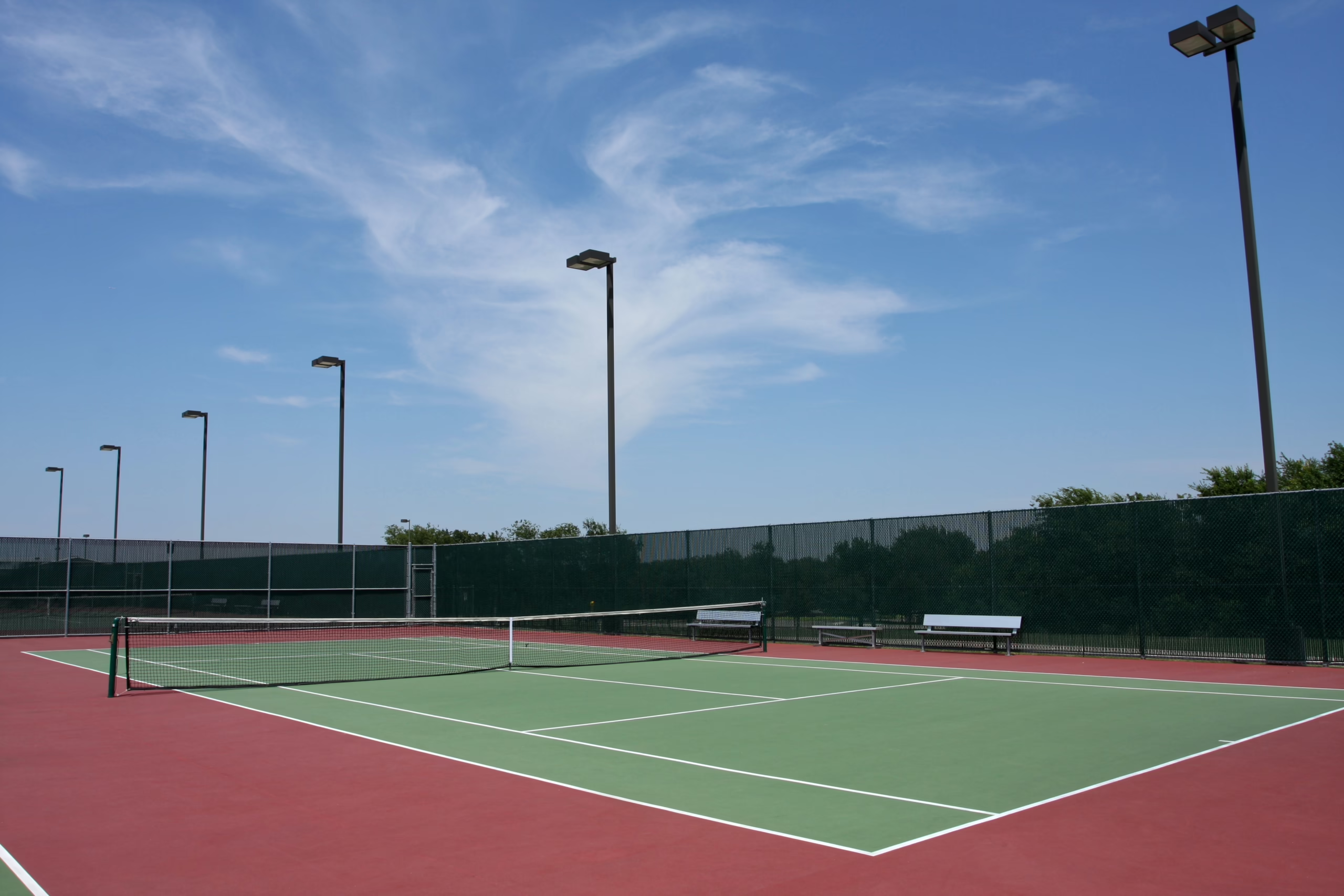
Placement is where the “art” of sports construction meets the “science” of engineering. The goal is to provide enough light to see a 100-mph serve without blinding the person trying to return it.
Most outdoor tennis courts utilize a 4-pole or 6-pole system.
Modern LED fixtures use specialized lenses to create Asymmetric Light Distributions. This means the light is pushed forward and across the court at a specific angle, rather than dropping straight down. This allows us to mount poles on the sidelines while still achieving perfect brightness in the center of the court.
Older lighting systems operate on alternating current that can cause a subtle flicker. This is often invisible to the eye but distracting to the brain during fast-paced play. High-quality LEDs are flicker-free. This helps the ball’s flight path remain smooth and predictable.
The most compelling reason for most facility managers to switch to LED is the bottom line. While the initial investment in LED fixtures is higher than traditional bulbs, the Return on Investment (ROI) is typically realized within 2 to 5 years.
A standard 1000W metal halide fixture actually draws about 1,080 watts when you factor in the ballast. A comparable LED fixture provides the same or better light output using only 300W to 400W.
As a premier tennis court construction company in NJ, we combine energy-efficient lighting with high-performance court surfacing to create facilities that are cheaper to operate and more attractive to members and players.
In today’s world, being a “good neighbor” is part of facility management.
Upgrading your tennis court lighting is an investment in the safety, playability, and financial health of your facility. At Keystone Sports Construction, we handle the entire process from initial photometric design and structural pole installation to the final aiming and commissioning of the lights.
Don’t let your facility be left in the dark. Whether you’re building a new complex from the ground up or retrofitting an existing court, our team is ready to help you see the game in a whole new light.